
How to use public transport in Europe: 2026 guide
Key takeaways
- Tap your bank card to ride in London, Rome, Milan, Brussels, Athens, Amsterdam and Madrid. In Paris and Berlin it only works on some services so far.
- Paper tickets are disappearing. Paris has phased them out on the metro, so use a Navigo Easy card or the app.
- Validate your ticket. Paper tickets often need stamping before you board, and fines run from about €41 in Budapest to €500 in Rome.
- Count your rides before buying a day ticket. In Prague, a 24-hour ticket costs the same as about four single rides. In Rome, it's closer to six.
- Airports cost extra. Many sit in an outer zone or charge a supplement, so check before you buy.
- Transit apps use real data. In our test, TfL Go used about 103 MB in 10 minutes and BVG Tickets about 17 MB. Set them up and save tickets on Wi-Fi.
- Signal underground varies. Prague and Berlin have mobile coverage across their whole metro. London is at about 60% of stations and aims for the whole network by the end of 2026.
- Trains beat flights on short hops. London to Paris, Madrid to Barcelona, Vienna to Budapest and Rome to Milan each take under three hours, centre to centre.
How public transport works in Europe
Most European cities run on the same few rules. Learn them once and every new metro feels familiar.
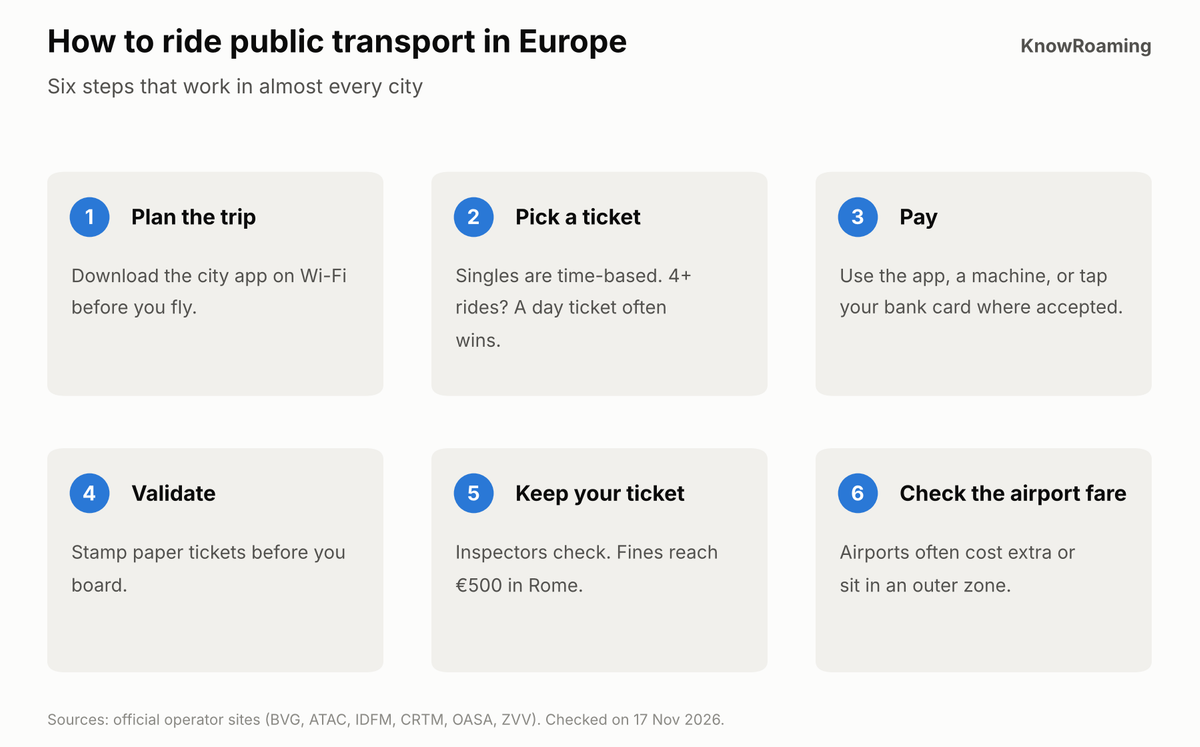
- Plan the trip. Use the official city app, Google Maps or Citymapper. Download apps on Wi-Fi before you travel, because they're large.
- Pick a ticket. Most single tickets are time-based. You get 60 minutes in Paris and Brussels, 90 in Milan, 100 in Rome and 120 in Berlin. If you'll ride four or more times, a day ticket or daily cap usually works out cheaper.
- Pay. Use the official app, a station machine, or tap a contactless bank card where it's accepted. Use the same card or phone for every tap, or the daily cap won't apply.
- Validate. Paper tickets often need stamping before you travel. In Berlin, you stamp outside the train. In Rome, you validate at the start and again when you switch to the metro.
- Keep your ticket until you exit. Many systems have no barriers and rely on inspectors. Fines are real: €100 in Athens, CHF 100 plus the fare in Zurich, and up to €500 in Rome.
- Check the airport fare. Airports often sit in an outer zone or charge a supplement. Copenhagen needs a 3-zone ticket, Madrid's metro adds €3, and Paris has a separate €14 airport ticket.
Travelling between cities
High-speed trains like the TGV and ICE usually arrive right in the city centre. Book fast and long-distance trains early. Local trains rarely need booking. For many cross-border trips, an Interrail pass covers 33 countries. Most high-speed and night trains still need a paid seat reservation on top.
Buses like FlixBus are usually cheaper than trains and reach smaller towns.
Popular routes by train
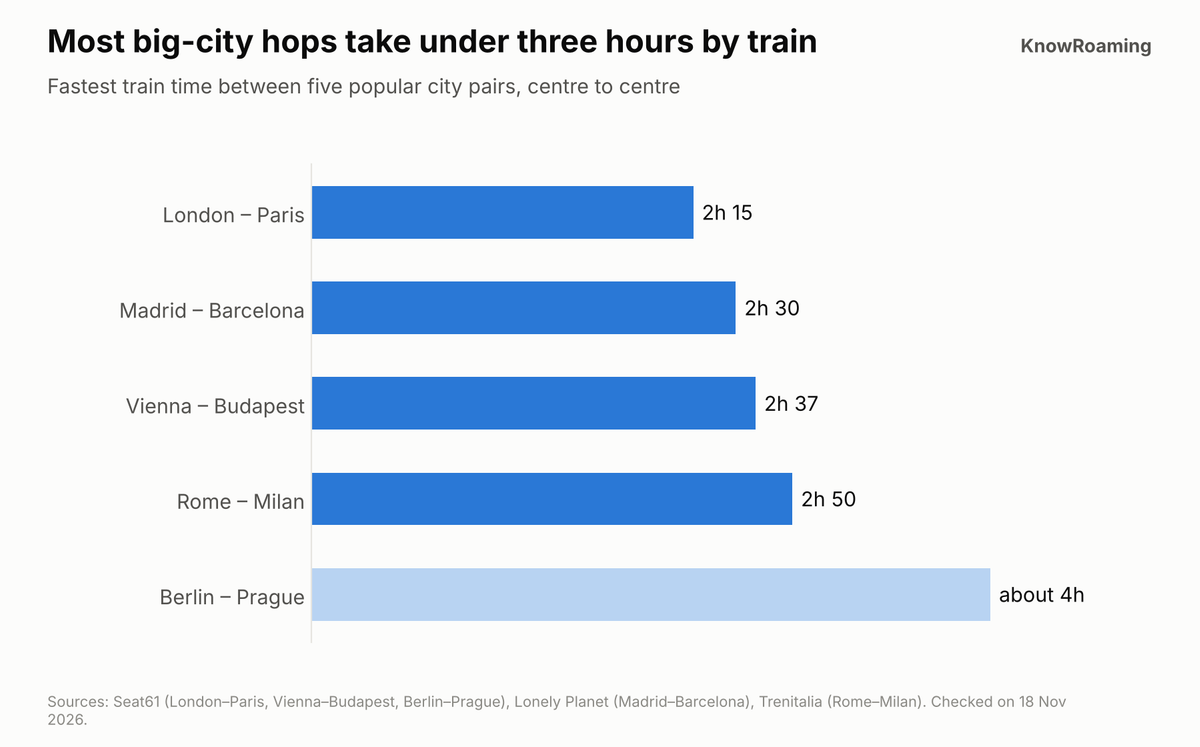
Four of Europe's busiest city pairs take under three hours by train, centre to centre. That's often quicker than flying once you count the airport trip and security.
| Route | Fastest Time | Trains | Advance fares from |
|---|---|---|---|
| London > Paris | 2h 15 | Eurostar | £51 one way (~€61) |
| Madrid > Barcelona | 2h 30 | Renfe AVE and AVLO, Ouigo, Iryo | Varies by operator |
| Vienna > Budapest | 2h 37 | Hourly Railjet and EuroCity, plus RegioJet | €9 (RegioJet) |
| Rome > Milan | 2h 50 | Frecciarossa, about 100 a day | Varies by date |
| Berlin > Prague | About 4h | EuroCity, about every 2 hours | €18.99 |
Book early, but read the rules
- Cheap fares tie you to one train. Vienna to Budapest costs from €13 on an advance ticket, against €52.70 for a flexible one. Advance tickets usually can't be changed or refunded.
- Book as early as you can. Eurostar opens bookings up to 11 months ahead.
- Compare operators on shared routes. Madrid to Barcelona has three high-speed operators, so prices vary a lot for the same trip.
- Check for trackwork. Most Berlin to Prague trains are cancelled on Mondays until 16 Oct 2027, so plan around it.
Rail passes
An Interrail pass covers trains in 33 countries and works as a mobile pass on your phone. There are Youth (12–27), Adult and Senior (60+) prices, and children aged 4–11 travel at reduced rates. Most high-speed and night trains need a paid seat reservation on top of the pass. A pass makes most sense if you're taking several long trips in a short time. For two or three trips, advance tickets are usually cheaper.
Night trains
A night train saves a hotel night and a travel day. ÖBB's Nightjet is the biggest network. It runs routes like Vienna to Rome, Vienna to Hamburg, Munich to Venice and Zurich to Amsterdam, with seats, couchettes and sleeper cabins.
Staying connected on the move
Trains cross borders, and your data should too. Download tickets to your phone before you board, in case signal drops between stations. With a Europe plan on your KnowRoaming eSIM, one plan covers you across the countries you pass through, so you don't need a new plan at each border.
The Europe transit index
We checked fares on the official transport operator site for 20 cities. Warsaw has the cheapest day ticket, at about €3.41. Copenhagen and Paris are the most expensive, at about €13 and €12.30.
| City | Single ride (EUR) | Day ticket or daily cap (EUR) | Tap your bank card | Cheapest airport to centre |
|---|---|---|---|---|
| Athens | 1.20 (90 min) | 4.10 | Yes | Express bus, 5.50 |
| Barcelona | 2.90 | 12.00 | Partly: some metro entrances | Metro airport ticket, 5.90 |
| Berlin | 4.00 (120 min) | 11.20 | Partly: buses and newer tram machines | ABC single, 5.00 |
| Brussels | 2.40 by card | 8.50 daily cap | Yes, including metro gates | Airport2City bus, 7.90 |
| Budapest | ~1.37 | ~7.55 | Partly: airport bus 100E | Bus 100E, ~6.86, ~40 min |
| Copenhagen | ~3.21 (2 zones) | ~13.38 City Pass, airport included | - | Metro M2, ~4.01, 13–15 min |
| Dublin | 2.00 (90 min, Leap card) | 6.00 daily cap | No, planned for 2028 | - |
| Helsinki | 3.30 in app | - | Yes | Train, ~4.80, 27–32 min |
| Kraków | ~1.36 (30 min) | ~4.54 | - | - |
| Lisbon | 1.90 | 7.25 | Yes, at metro gates | - |
| London | ~3.71 peak, Zone 1 | ~10.67 daily cap, Zones 1–2 | Yes | Elizabeth line, ~18.57 |
| Madrid | 1.50–2.00 | 10.30 tourist ticket | Yes, since June 2026 | Express bus, 5.00 |
| Milan | 2.20 (90 min) | 7.60 | Yes; daily cap after 4 trips | - |
| Oslo | ~4.35 | - | - | - |
| Paris | 2.55 metro | 12.30, airports excluded | Partly: buses now, metro from 2027 | Airport ticket, 14.00 |
| Prague | ~1.47 (30 min, app) | ~5.73 in app | Partly: card terminals sell tickets | Bus and metro, ~1.88, ~35 min |
| Rome | 1.50 (100 min) | 8.50 | Yes; 8.50 daily best fare | - |
| Vienna | 1.50 digital | 9.70 | - | - |
| Warsaw | ~1.00 (75 min) | ~3.41 | - | - |
| Zurich | ~5.08 | ~10.17 | - | - |
How we built it: fares come from each city's official operator, checked on 17 Nov 2026. "~" means we converted from local currency at the ECB rate for 16 Nov 2026. "–" means we couldn't confirm it on the operator's site.
Will your phone work underground?
Prague, Berlin and Paris report mobile coverage across their whole metro. Elsewhere it depends on the line and your network. No single dataset compares cities, so we checked what each operator or carrier has said publicly.
| City | Signal underground | Last confirmed |
|---|---|---|
| Prague | Whole network, stations and tunnels, 3 networks | Dec 2021 |
| Berlin | All 9 lines and 175 stations on 4G, 3 networks; 5G starting | May 2024 |
| Paris | 4G across stations, tunnels and trains, 4 networks | June 2020 |
| London | About 60% of stations plus some tunnels; whole network targeted by end of 2026 | June 2026 |
| Rome | Line A on 5G; Line B in progress; Line C none reported | April 2026 |
| Lisbon | All 4 lines on one network (DIGI) | September 2026 |
| Munich | Whole U-Bahn on 5G for one network (o2) | July 2022 |
| Oslo | 4G in T-bane tunnels, 2 networks | April 2016 |
| Budapest | 5G on line M1 for one network, more lines planned | June 2024 |
| Madrid | 5G at Sol for one network; whole metro targeted for 2026 | January 2026 |
In other cities, assume coverage varies by line and network. Plan your route before you go underground.
How much data do your apps use?
Transit apps
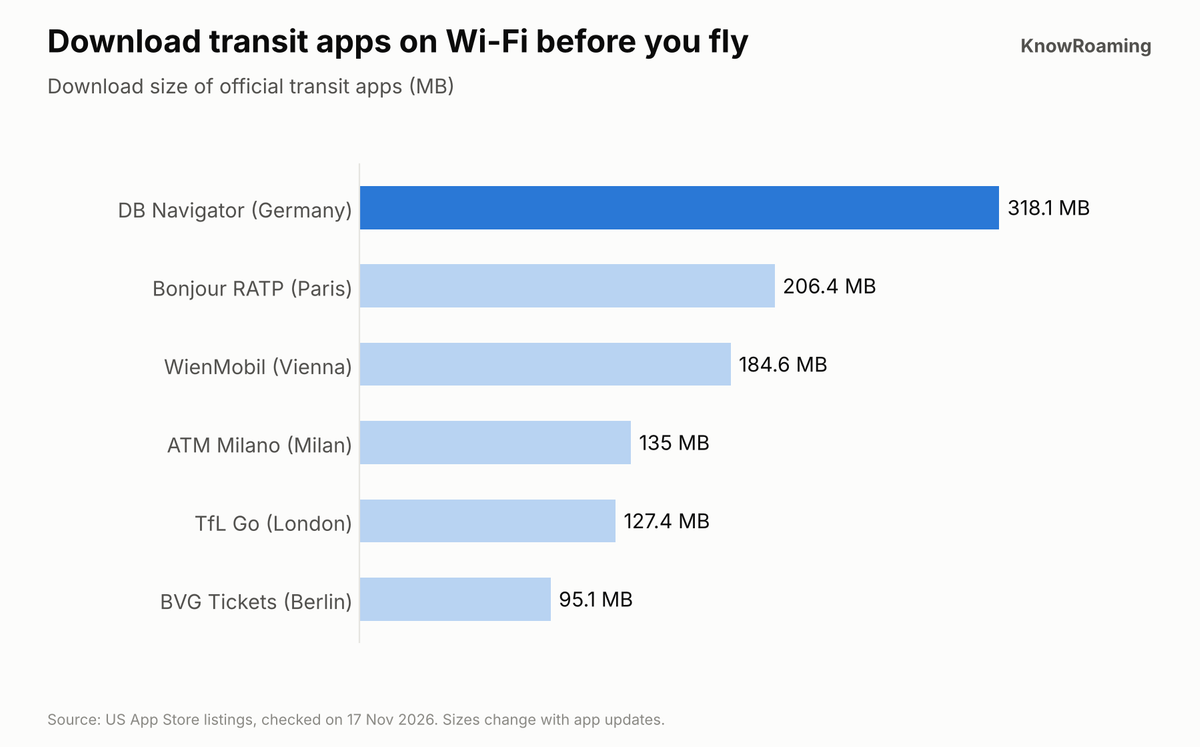
The official apps are big downloads, so get them on Wi-Fi before your trip.
| App | City | Download Size |
|---|---|---|
| DB Navigator | Germany (trains) | 318.1 MB |
| Bonjour RATP | Paris | 206.4 MB |
| WienMobil | Vienna | 184.6 MB |
| ATM Milano | Milan | 135 MB |
| TfL Go | London | 127.4 MB |
| BVG Tickets | Berlin | 95.1 MB |
How much data transit apps use in 10 minutes
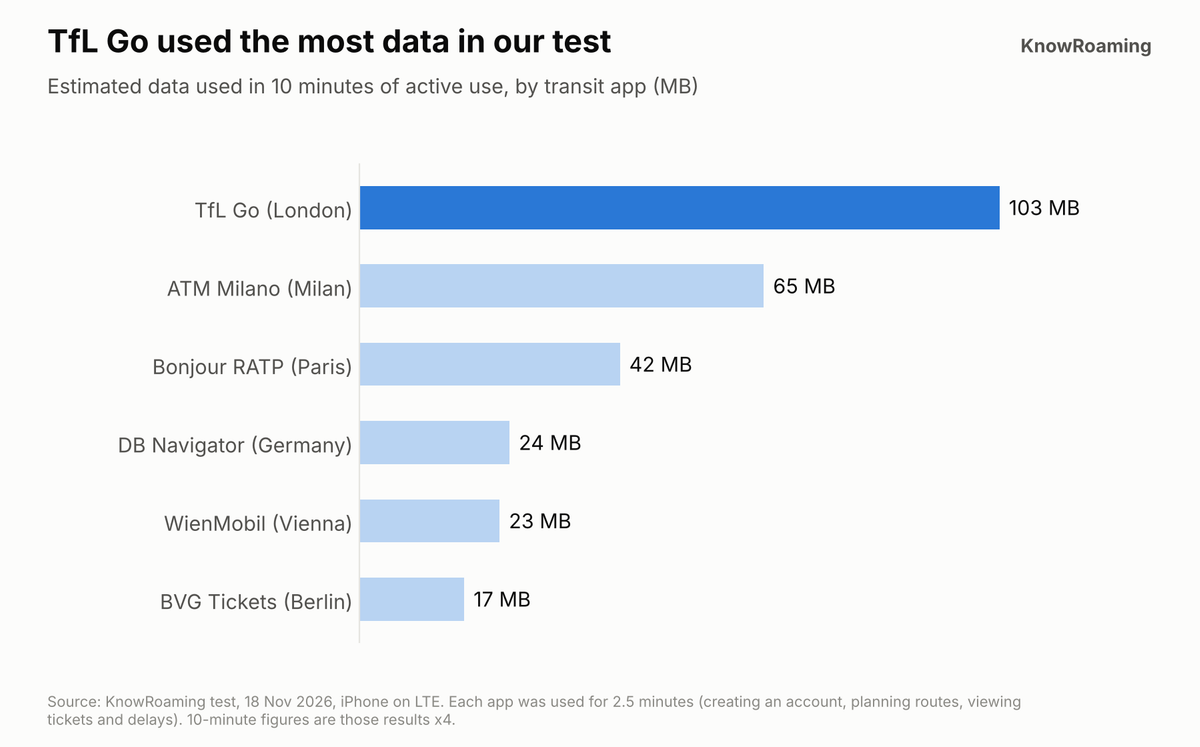
| App | City | Measured for 10 min (MB) |
|---|---|---|
| DB Navigator | Germany (trains) | 103 MB |
| Bonjour RATP | Paris | 65 MB |
| WienMobil | Vienna | 42 MB |
| ATM Milano | Milan | 24 MB |
| TfL Go | London | 23 MB |
| BVG Tickets | Berlin | 17 MB |
What we found
- A big download doesn't mean heavy use. DB Navigator is the largest download at 318 MB, but used only about 24 MB in 10 minutes. TfL Go is one of the smaller downloads and used the most.
- It adds up across a trip. Ten minutes in each of the six apps came to about 274 MB, more than a quarter of a gigabyte.
- Set up on Wi-Fi. Our test included creating an account in each app, which uses more data than a normal ride. Do it at home or at the hotel, and save your tickets before you head out.
How we tested: on 18 Nov 2026 we used each app for 10 minutes on an iPhone over LTE. We created an account, planned several routes, opened tickets and read delay updates. We read each app's usage from the phone's mobile data settings. Results vary by phone, settings and network.
Apps you use while travelling
We tested six everyday apps on a KnowRoaming eSIM, using an iPhone on cellular data only. Each app ran for 10 minutes, and we reset the data counter before each one.
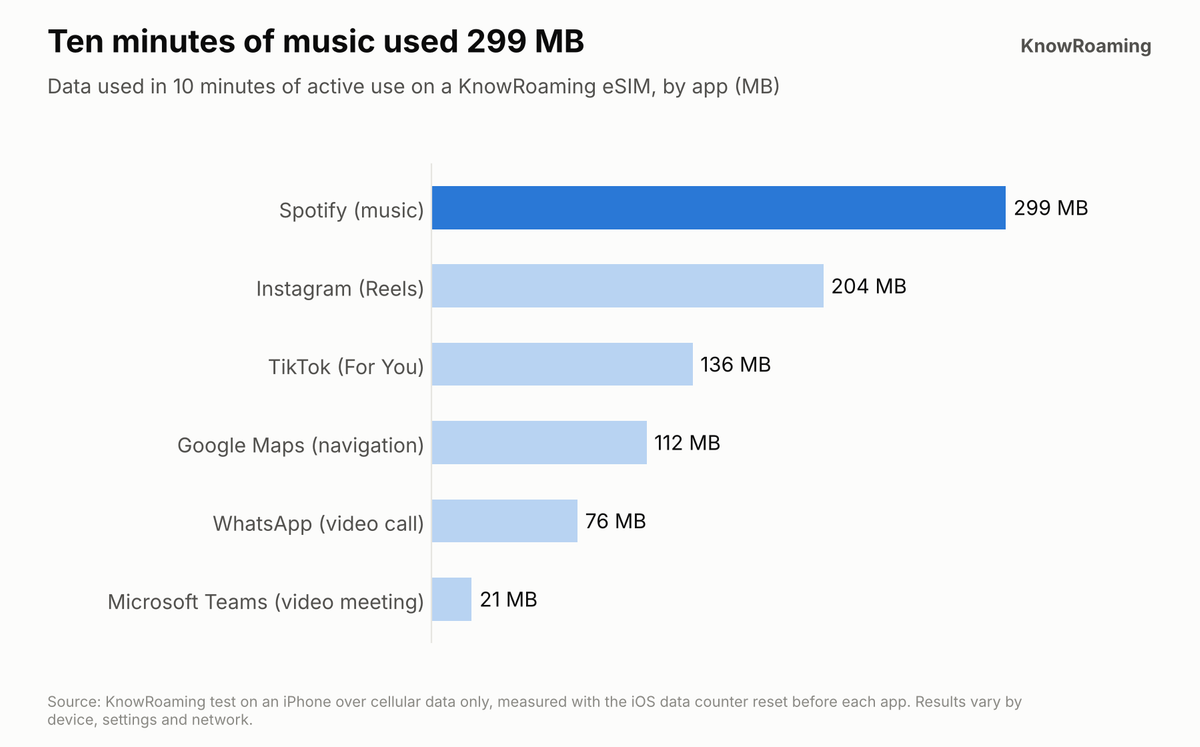
- Music streams the most. Ten minutes of Spotify used 299 MB. Download playlists on Wi-Fi before your trip.
- Short video adds up fast. Instagram Reels used 204 MB and TikTok 136 MB in 10 minutes each.
- Video calls cost less than you'd think. A 10-minute WhatsApp video call used 76 MB, and a Teams video meeting used 21 MB.
- An hour of mixed use came close to 1 GB. All six apps together used 848 MB, plus 55 MB in the background.
- An idle phone barely sips data. Left alone with the screen off, it used 4.2 MB in an hour.
Want to track your own usage? Read our guide to monitoring your eSIM data usage.
City guides
London
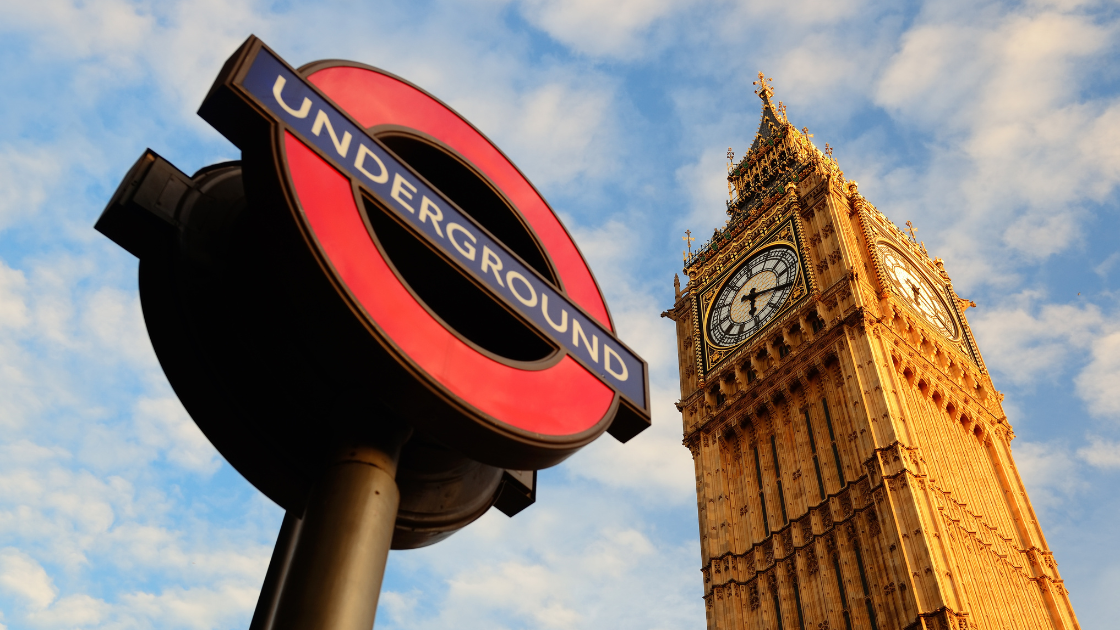
Tap a contactless card in and out on the Tube, buses and trains. Your spending caps at £8.90 a day in Zones 1–2. Plan routes in TfL Go.
Good to know
- Night Tube: runs Friday and Saturday nights on the Victoria, Jubilee, Central, Northern and Piccadilly lines, with normal off-peak fares. Some branches are left out, such as Heathrow T4. (Visit London)
- Strikes this winter: RMT drivers have announced 24-hour walkouts on 26 Nov, 17 and 19 Dec, 4 and 6 Jan, and 17, 23 and 25 Feb. Check before you travel. (Time Out)
- Step-free access: more than a third of Tube stations are step-free, and so is every Elizabeth line station and bus. (TfL)
What travellers say
- Each traveller needs their own card or phone. One card can't pay for two people. (Rick Steves forum, Jul 2025)
- The weekly cap runs Monday to Sunday, not any seven days, which catches visitors out. (same thread)
Questions travellers ask
- Can I use contactless on the Tube? Yes. Tap a contactless card or phone on every TfL service, in and out, with the same card each time. Daily caps stop you overpaying. Non-UK cards may add overseas fees. (TfL)
- Do I need an Oyster card? Not if you have contactless. Oyster costs £7 plus credit and suits visitors without a contactless card. (TfL)
- What time does the Tube close? Trains run from about 5am to around midnight, Monday to Saturday, with shorter hours on Sunday. Five lines run all night on Fridays and Saturdays. (Visit London)
- How do I get from Heathrow to central London? The Piccadilly line is cheapest, from £5.50 and under an hour. The Elizabeth line takes under 45 minutes for £13.90. Heathrow Express reaches Paddington in about 15 minutes, from £10 booked ahead. (Heathrow)
Paris
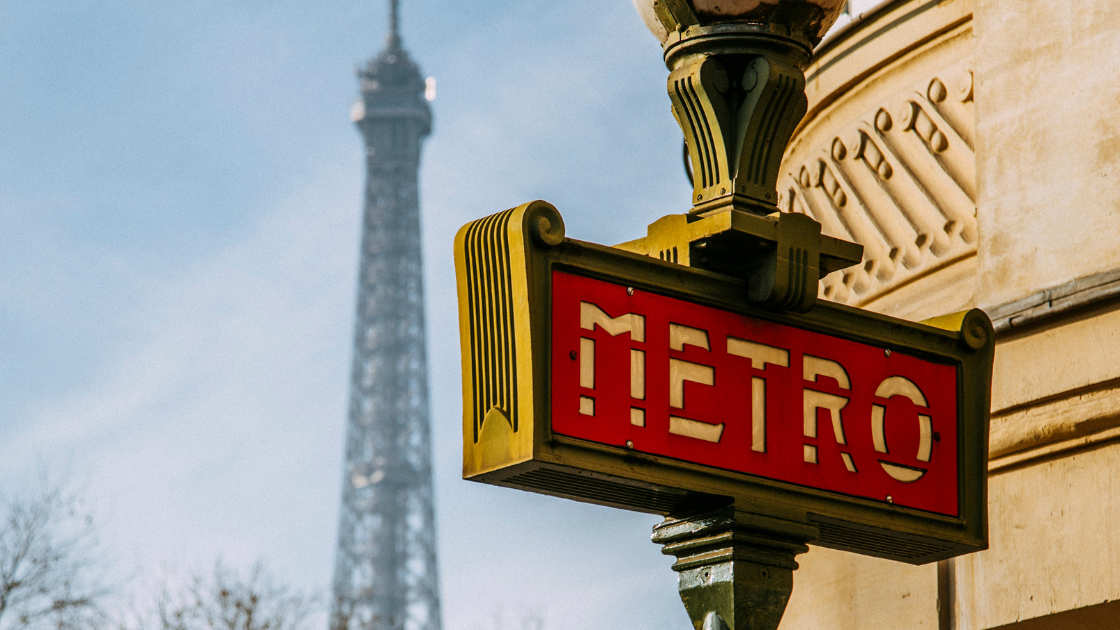
A metro ticket costs €2.55 and a day ticket €12.30. The day ticket doesn't cover the airports, which have their own €14 ticket.
Good to know
- Paper tickets are gone. Paris stopped accepting them on the metro and RER in June 2026. Use a Navigo Easy card (€2) or the Bonjour RATP app. (Sortiraparis)
- Last trains: the metro runs until about 1:15am, or 2:15am on Friday and Saturday. After that, Noctilien night buses run from hubs like Châtelet and Gare de Lyon. (RATP)
- Accessibility: line 14 is the only fully step-free metro line. Buses, trams and the RER are better options. (IDFM)
What travellers say
- Don't stand by the doors scrolling your phone. That's where snatch thefts happen. (Rick Steves forum, Aug 2025)
- The risk is concentrated at busy tourist stations rather than across the whole network. (same thread)
Questions travellers ask
- How do I buy a metro ticket? Load tickets onto a €2 Navigo Easy card or buy them in the Île-de-France Mobilités app. One ticket covers the metro, RER and trains in Paris, but not the airports. (IDFM)
- Can I tap my bank card on the metro? Not yet on most lines. Card payment started at Orly on line 14 in June 2026, line 1 follows in July 2027, and every line by 2030. (The Local)
- What time does the metro close? Around 1:15am on weekdays, and around 2:15am on Fridays, Saturdays and the night before public holidays. It doesn't run 24 hours. (RATP)
- How do I get from Charles de Gaulle to central Paris? The RER B takes 25–30 minutes and needs the €14 airport ticket. Buses 350 and 351 are cheaper but take 60–90 minutes. (IDFM)
- Is the Paris metro safe? Pickpocketing is the main risk. Close your bag, keep your wallet in an inside pocket and stay aware when using your phone. (RATP)
Rome
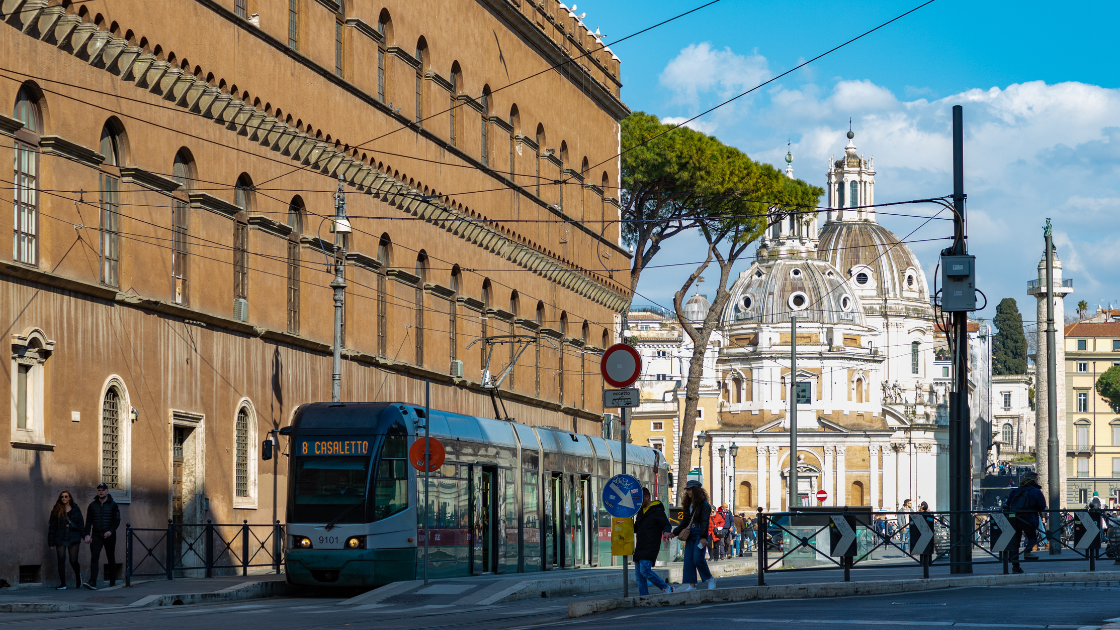
Tap your bank card on the metro and every bus and tram line. You'll never pay more than €8.50 a day.
Good to know
- One card per person. If the reader detects two cards at once, it fails. ATAC never sends texts about Tap&Go, so treat any such message as a scam. (ATAC)
- Strikes usually fall on Fridays. Service is often guaranteed only in the early morning and late afternoon. (Wanted in Rome)
- Paper tickets: validate at the start and again when you switch to the metro. Fines run from €100 to €500.
What travellers say
- On a packed 64 bus, one traveller couldn't reach the validator and was fined anyway. Tap your card as you board instead. (Rick Steves forum, Jun 2024)
- Crowded buses and metro cars are where pickpockets work, so keep bags in front. (same thread)
Questions travellers ask
- How do I get from Fiumicino Airport to the city? The Leonardo Express runs non-stop to Roma Termini in about 32 minutes, every 15 minutes, for €14. Standard bus and metro tickets aren't valid on it. (Trenitalia)
- Can I tap and go? Yes, on the metro, buses and trams. Tap on every vehicle with the same card, and you'll never pay more than €8.50 in 24 hours. (ATAC)
- Do I need to validate my ticket? Yes, at the start and again on each new vehicle. If a validator is broken, write the date, time and stop on the ticket. Fines drop to €50 if paid within 5 days. (ATAC)
- What are the metro hours? Rome's three lines run from 5:30am to 11:30pm Sunday to Thursday, and to 1:30am on Friday and Saturday. (Roma Mobilità)
Berlin
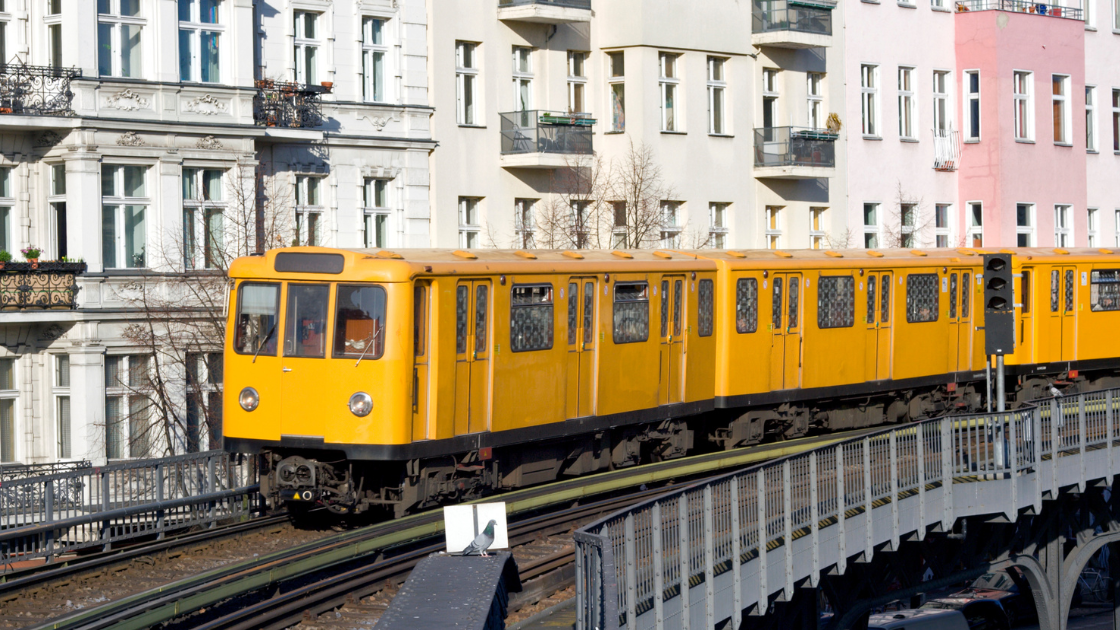
A single AB ticket lasts 120 minutes for €4.00. Stamp paper tickets on the platform before you board, and activate app tickets before your trip starts.
Good to know
- All night at weekends: the U-Bahn runs through Friday and Saturday nights. On weekdays, night buses take over after about 1am. (Walk of Berlin)
- Airport zone: BER sits in zone C, so buy an ABC ticket.
- Step-free: about 86% of U-Bahn stations and every bus are step-free. (BVG)
- Signal: the whole U-Bahn has 4G, so you can plan on the move.
What travellers say
- Ticket inspectors are often in plain clothes, so keep your ticket ready even if no one seems to be checking. (Rick Steves forum, 2016)
- Check your route in an app before you set off, as lines close for works. (Rick Steves forum, Jun 2025)
Questions travellers ask
- Which ticket do I need from BER Airport? BER is in zone C, so buy an ABC ticket. The FEX Airport Express reaches Hauptbahnhof in about 23 minutes, every 15 minutes. (BVG, BER)
- Do I need to validate my ticket? Yes. Stamp paper tickets on the platform before boarding the U-Bahn or S-Bahn, or on board buses and trams. Activate app tickets before you travel. (BVG)
- Is Berlin public transport 24 hours? At weekends, the U-Bahn runs all night. On weekday nights, night buses marked "N" take over. (BVG)
- How do I pay? Use station machines (cash or card), the BVG app (Apple Pay, Google Pay, PayPal), or tap a card with the bus driver. (BVG)
Prague
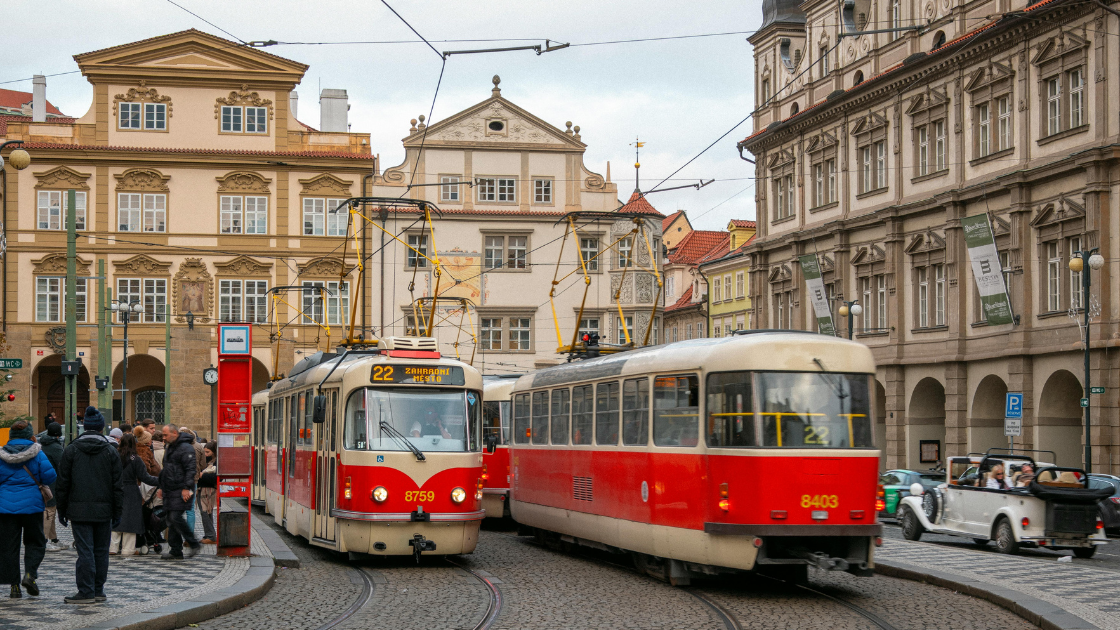
Buy in the PID Lítačka app and save money: 36 CZK for 30 minutes, against 39 CZK on paper. From the airport, bus 59 and the metro get you to the centre in about 35 minutes.
Good to know
- Tap on board: trams and buses have contactless terminals by the doors. Tickets bought there are valid straight away. (PID)
- App tickets need a minute. They only become valid one minute after you activate them, and inspectors can fine you in that minute. (PID)
- Stamp once. Re-stamping a paper ticket when you change lines makes it invalid. (Prague.eu)
- Night trams 91–99 run about every 30 minutes, and bus 910 runs to the airport. (Prague.eu)
What travellers say
- Visitors find the trams and metro easy to use, and a day pass keeps it simple. (Rick Steves forum, 2018)
- Inspectors do check, and fines are steep for riding without a valid ticket. (same thread)
Questions travellers ask
- How do I get from the airport to the city centre? Bus 59 connects to metro A and bus 100 to metro B, on a standard 90-minute ticket (CZK 46 in the app). The Airport Express bus to the main station costs CZK 200. (Prague Airport, PID)
- How do I pay? Use the PID Lítačka app, a touchscreen machine (contactless accepted) or the card terminals on trams and buses. App tickets are cheapest. (PID)
- Do I need to validate my ticket? Only paper tickets from button machines and ticket offices, and only once, on first use. Tickets from touchscreens and on-board terminals are already valid. (PID)
- Is the Prague metro 24 hours? No. It runs from 5am to midnight. After that, night trams 90–99 run every 30 minutes until 4:30am. (PID)
Madrid
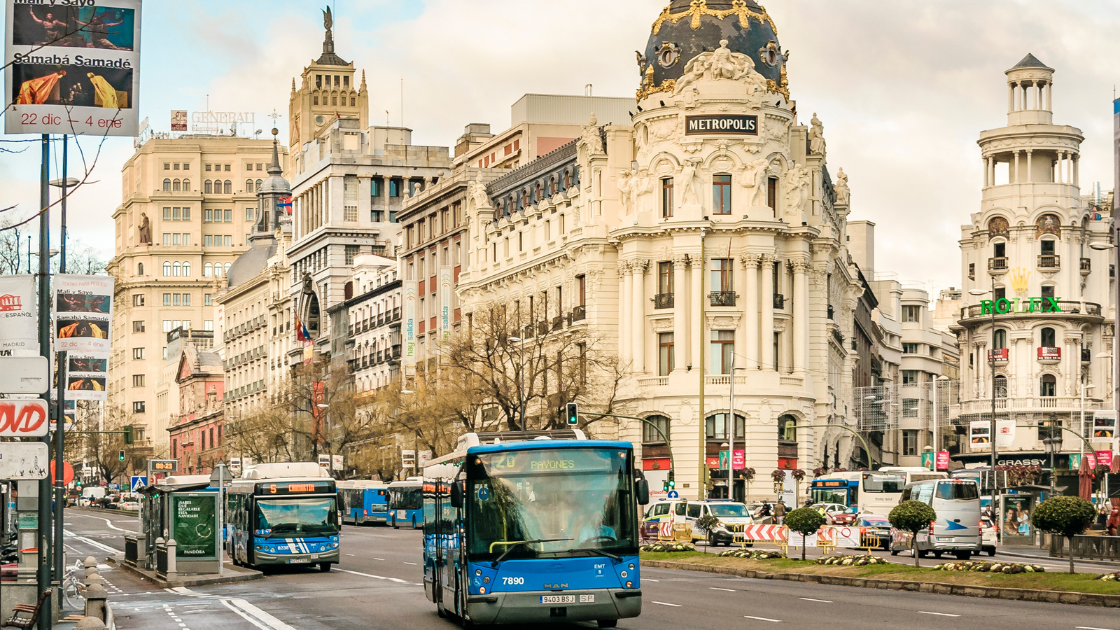
Since June 2026 you can tap a bank card, phone or watch at every metro gate, at €1.50 a trip. (Infobae) Metro rides to the airport add a €3 supplement, so the €5 express bus is often the simpler choice.
Good to know
- Tourist Travel Pass: 1 to 7 days, from €10.30, and the zone A pass includes the airport supplement. (esMadrid)
- Lifts: the metro has 579 lifts, with more stations being upgraded. Check step-free access for your stations before you go. (CRTM)
What travellers say
- Most central sights are walkable, so tourist passes often aren't worth it. (Rick Steves forum, Feb 2026)
- Two people can share one Multi card with a 10-trip pack, bringing a ride down to about €1.20. (same thread)
Questions travellers ask
- How do I get from Madrid Airport to the centre? Metro line 8 runs from T4 to Nuevos Ministerios in under 20 minutes, with a €3 airport supplement. The 24-hour Airport Express bus costs a flat €5 to Atocha or Cibeles. (Aena, CRTM)
- How do I buy metro tickets? Tap a bank card or phone at the gates, or load tickets onto a €2.50 Multi card. A 10-trip ticket costs €7.30. (esMadrid)
- Is the Madrid metro 24 hours? No. It runs from 6am to 1:30am, every 15 minutes after midnight. (esMadrid)
- Do I pay extra for the airport? Yes, a €3 supplement on single and 10-trip tickets. The Tourist Travel Pass includes it. (CRTM)
FAQs
Can I use my bank card on public transport in Europe? In many cities, yes. London, Rome, Milan, Brussels, Athens, Amsterdam and Madrid accept contactless cards. Paris and Berlin only partly accept them, and Dublin plans to start in 2028.
Do I need to validate my ticket? Usually, yes, for paper tickets. Stamp it in the machine on the platform or on board before you travel. Fines for an unvalidated ticket reach €500 in Rome.
Is a day ticket worth it? Only if you'll ride a lot. In Prague a day ticket equals about four single rides, and in Rome about six.
Does my phone work on the metro? In Prague, Berlin and Paris, coverage reaches the whole network. In London it's at about 60% of stations, with the whole network targeted by the end of 2026. Elsewhere it varies by line and network.
Is Interrail for EU residents only? No. Interrail is based on where you live, not your nationality. Residents can use the pass in their own country on certain travel days.
What's the emergency number in Europe? 112 works across the EU.
Sources
- London: TfL fares, TfL mobile coverage
- Paris: IDFM fares 2026, bank card rollout, 4G coverage
- Berlin: BVG single, BVG 24h, U-Bahn 4G
- Madrid: CRTM tourist ticket, airport, bank cards at gates, 5G
- Barcelona: TMB fares
- Rome: ATAC BIT, Tap&Go, 5G report
- Milan: ATM
- Brussels: STIB fares, Airport line
- Vienna: Wiener Linien
- Prague: PID tariff 2026, metro signal
- Budapest: BKK prices, M1 5G
- Warsaw: ZTM; Kraków: MPK
- Lisbon: Metro fares 2026, DIGI coverage
- Athens: OASA prices, contactless
- Dublin: TFI 90 Minute fare
- Copenhagen: Metro tickets; Oslo: Ruter, T-bane 4G
- Helsinki: HSL; Zurich: ZVV; Munich: o2 5G
- Interrail Global Pass
- ECB exchange rates, 16 Nov 2026
Travelling between cities: Seat61 London to Paris, Seat61 Vienna to Budapest, Seat61 Berlin to Prague, Lonely Planet Madrid to Barcelona, Trenitalia Rome to Milan, Nightride: the ÖBB night train network
常见问题解答
Yes. Keep data roaming on for the KnowRoaming line, give the phone a minute after the crossing, and it joins the local partner network on its own. If it doesn't, airplane mode on for 30 seconds and off again forces a fresh search.
An unlimited plan, with a daily high-speed allowance, covers navigation, bookings, calls, and a laptop on the hotspot for a whole month and works out to the lowest daily rate. Add or top up from the app anywhere on the route.
A fixed plan costs less overall; an unlimited plan (a daily high-speed allowance, then slower) works out to a lower daily rate the longer you stay. The price depends on how much data you want and how many days you're staying; every current option and price is in the plan selector at the top of this page.
Once an eSIM is on your phone, it works like a regular SIM card: it can function even when your phone isn't connected to the internet, for example for calls and texts on a line that includes them. A KnowRoaming eSIM is data-only, so you need a data connection to use it.
Yes. KnowRoaming covers 200+ destinations, and a single Global eSIM connects in 144 of them, so you can cross borders without switching or changing SIMs. Regional plans for Europe, Asia, Africa, the Caribbean, LATAM, and more work the same way.
Yes, KnowRoaming offers eSIM plans that work across multiple countries, so you can stay connected without buying a new SIM card in each destination. Whether your family is visiting three countries in Europe or hopping between islands, one KnowRoaming eSIM can keep you online for maps, translations, and entertainment in over 200 destinations.