One app, total control.
Manage your plans, your data and your eSIM from your phone, wherever you land.




Yes. The Africa plan covers Madagascar and 30 other countries, including Mauritius, Réunion, Mayotte, and Seychelles, and your phone switches networks by itself when you land. Madagascar is also on the Global plan. See our support article on whether a region plan covers every country in it.
In Madagascar your plan connects to Yas, the network formerly known as Telma, on 4G LTE; 5G is not part of this plan. Your phone joins the network automatically once your eSIM is turned on. If it hasn't connected a minute after landing, work through the no-signal checklist.
In the park towns, yes, on 4G. Inside Ranomafana, Isalo, Andasibe, and the Tsingy, no, on any network. Save maps, permits, and the guide's number before you go in.
Yes, with 4G in Hell-Ville, Ambatoloaka, and the resort areas. On the smaller islands and the boats, the signal fades. Book the boats in town while you have data.
A fixed plan costs less overall; an unlimited plan (a daily high-speed allowance, then slower) works out to a lower daily rate the longer you stay. The price depends on how much data you want and how many days you're staying; every current option and price is in the plan selector at the top of this page.
In the app: open My eSIMs, choose your Madagascar plan, and tap Top up. The extra data lands on the same eSIM within a few seconds, with nothing new to add or scan. Full steps are in Top up your plan: add data or days without a new eSIM.
Weeks ahead. Your plan doesn't start until you connect at your destination, so a plan bought a month before departure is still complete when you land. Start your plan within 90 days of buying it. See when your plan starts and how the days are counted.
Often not. Coverage is strong in Antananarivo, Antsirabe, Fianarantsoa, Tuléar, Diego Suarez, and on Nosy Be, but on the western roads, on the smaller islands, and between the towns expect long stretches with no signal on any network.
Manage your plans, your data and your eSIM from your phone, wherever you land.
Install your eSIM before you fly. It's live the moment you land, nothing to check, nothing to remember.
Already with us? Get the app on the App Store or Google Play.
Madagascar is a country of long roads, taxi-brousses that leave when full, and national parks where the guide confirms by message the night before, and the arrivals hall at Ivato is the place to have a phone that already works. The best eSIM for Madagascar is the one installed at home, on Wi-Fi, so the hotel's driver is found and tomorrow's departure on the RN7 is confirmed before the visa desk.
Below: how a Madagascar plan works, how to install your eSIM before you fly, what to expect in Antananarivo, on the road south, and on the islands, and which plan fits when Mauritius or Réunion is on the same trip.
Install it once. Add a plan for each trip. Top up when you need more data. Your home SIM stays in your phone, with your number on it.
African itineraries change, and most travel eSIMs make you start over every time they do. KnowRoaming doesn't. You install the KnowRoaming eSIM on your phone once. KR.One, the technology behind it, lets that one eSIM hold plans for every destination. Then you add a plan for each trip: one country when you're staying put, the Africa plan when the route crosses borders, and whatever comes next after that. Nothing to scan again, nothing to delete when you get home.
Your plan starts when you connect in Madagascar, not when you buy. Buy it weeks ahead, install your eSIM at home, and a delayed flight costs you nothing. The full rule is in when your plan starts and how the days are counted.
Choose a fixed plan for a set amount of data at the lowest overall price, or an unlimited plan when you'd rather not count. Unlimited plans give you a daily high-speed allowance, then a slower speed until the allowance resets the next day. If a fixed plan runs low, top up in the app and the extra data lands on the same eSIM. Hotspot works on every plan, fixed or unlimited; a laptop or a travel partner's phone shares the same eSIM data.
See it in two minutes: Meet KR.One, Install on iPhone, or Install on Samsung.
Do this at home on Wi-Fi. It takes about a minute.
Prefer a QR code? The checkout page and your confirmation email both carry one; scan it from your phone's settings. Every tap is in how to add your plan, start to finish, or watch the iPhone QR walkthrough or the Samsung QR walkthrough. Still no signal after landing? Work through the no-signal checklist.
Ivato airport is about 45 minutes to an hour from central Antananarivo in traffic, and most visitors are met by the hotel or a pre-booked driver; a visa on arrival is available for most passports, paid in cash. The ariary is the currency, cards work in the capital's better hotels and a few restaurants, and cash covers nearly everything else; the ATMs in the cities take foreign cards, the ones in the towns often don't.
Getting around the country is by taxi-brousse, hired car with a driver, or the domestic airline, whose schedules change; the distances are long and the roads slow, and two hundred kilometers is a day. Antananarivo's Rova palace, the Analakely market, and the lake are the first day.
The RN7 from Antananarivo to Tuléar is the classic route, a week or more through Antsirabe's rickshaws, Ranomafana's rainforest and its lemurs, Fianarantsoa, the Anja reserve's ring-tails, and the canyons of Isalo before the coast at Ifaty. Yas's 4G holds in the towns along the road; the parks and the stretches between towns drop out on every network.
Antsirabe's hot springs and its rickshaws, the Zafimaniry woodcarving villages off the road near Ambositra, and the Anja reserve's lemurs an hour south of Fianarantsoa are the stops worth a day each; the tea and wine estates around Fianarantsoa are the surprise. Book each night's guesthouse from the previous town by message, since the next one may not have signal.
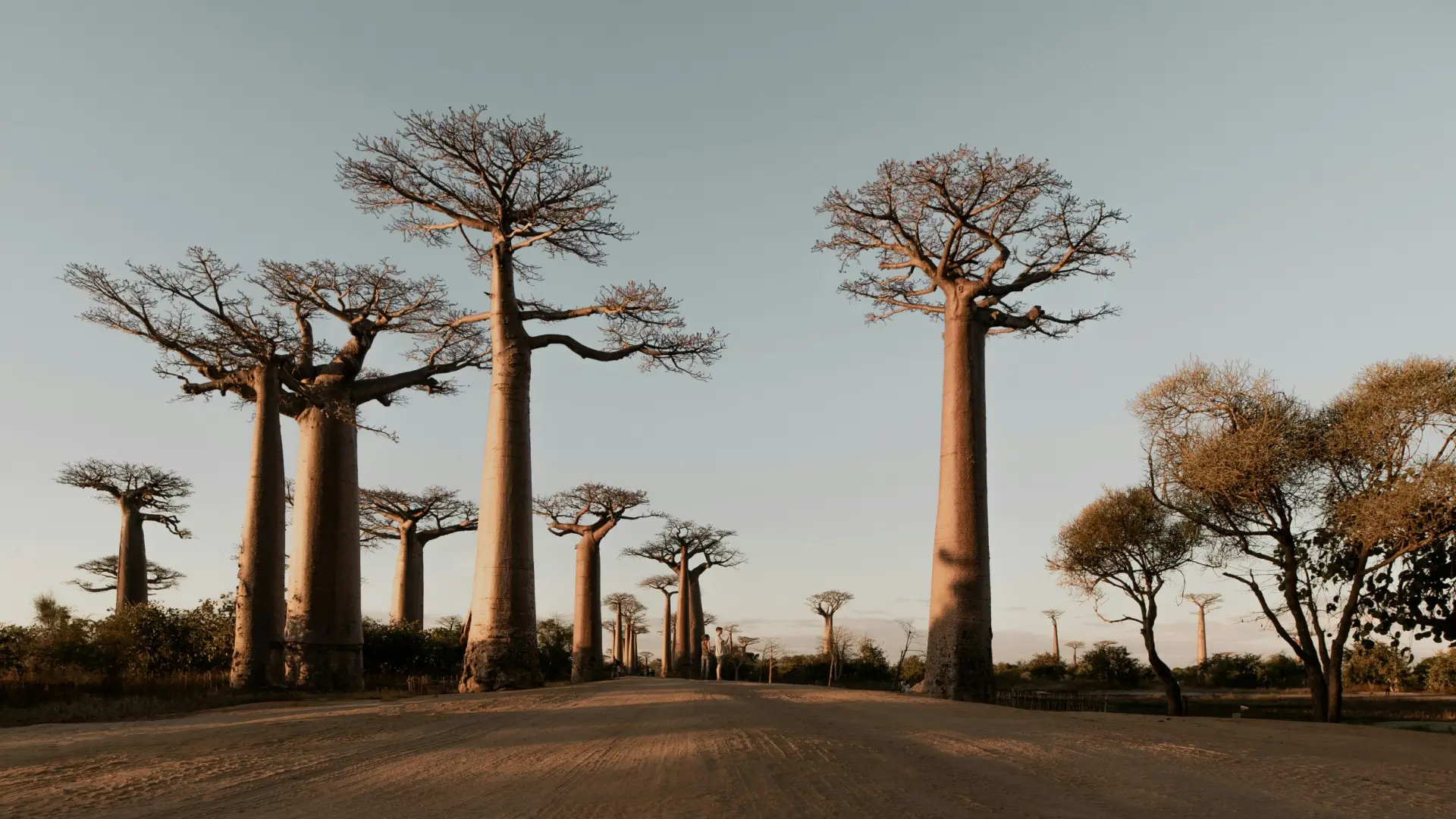
Andasibe, three hours east of the capital, is the indri's forest and the easiest park to reach; the Avenue of the Baobabs at Morondava, the Tsingy de Bemaraha's limestone needles, and the Kirindy forest are the west, a flight or two long days of road. All are offline once you leave the last town; download maps, save the guide's number, and expect the phone to be a camera.
Nosy Be, a flight north, is the beach island, with the resorts, the diving, and the boat trips to Nosy Komba and Nosy Iranja; Île Sainte-Marie on the east coast is the whales from July to September. Nosy Be's main towns have 4G; the smaller islands and the boats do not. Book the boats in Hell-Ville while you have data.
Madagascar is on the Africa plan, 31 countries on one plan that also covers Mauritius, Réunion, Mayotte, and Seychelles, the usual island add-ons by air, with the phone switching networks by itself when you land; it is also on the Global plan. A Madagascar-only plan stops at the coast. Read whether a region plan covers every country in it for the detail.
Your plan connects to Yas on 4G LTE. There is no 5G on this plan. Coverage is strong in Antananarivo, Antsirabe, Fianarantsoa, Tuléar, Diego Suarez, and on Nosy Be, and holds in the towns along the main roads. Your phone picks the network automatically once the plan is on; there is nothing to choose by hand.
In the parks, on the western roads, on the smaller islands, and between the towns, expect long stretches with no signal on any network. Power cuts are common outside the capital, so a power bank keeps the phone useful. Save what you need in town.
Most current iPhone, Samsung Galaxy, and Google Pixel phones support eSIM. Check yours before you add a plan; it takes a few seconds. On iPhone, go to Settings > General > About and look for an EID or Available SIM. On Android, go to Settings > Network & Internet > SIMs and look for an option to add an eSIM. On Samsung, dial *#06# and look for an EID.
Your phone also needs to be carrier-unlocked. If you're not sure, the same check shows you where to look.
Adding a Madagascar plan doesn't touch your regular SIM. Calls and texts on your usual number keep working exactly as before. The new plan handles data while you're there, and most phones run both at once without you doing anything else. Bank codes and two-factor texts still arrive on your home number, as long as that line stays switched on.
One plan. No roaming surprises. Live the moment you land.
For Africa the alternatives are a home-carrier roaming rate that is often not offered at all, a local SIM in each country with registration paperwork at each border, or lodge Wi-Fi that works in the bar and nowhere else. A Madagascar plan added at home beats all three: one price agreed before you fly, live the second you land, and one plan across every border on the route.
Real travelers rate KnowRoaming 4.5 out of 5 on Reviews.io. More than a decade in travel connectivity, more than 200 destinations, and support that doesn't clock off: WhatsApp and live chat, any time, any day.
Get the app on the App Store or Google Play.
Very easy to use and great coverage
Saleh
Jeddah, SA
I enjoyed using your service it really comes in handy
Fhatuwani
Excellent option when traveling, I fo suggest that yiu add the option to make a normal call to.
Anonymous
London, GB